

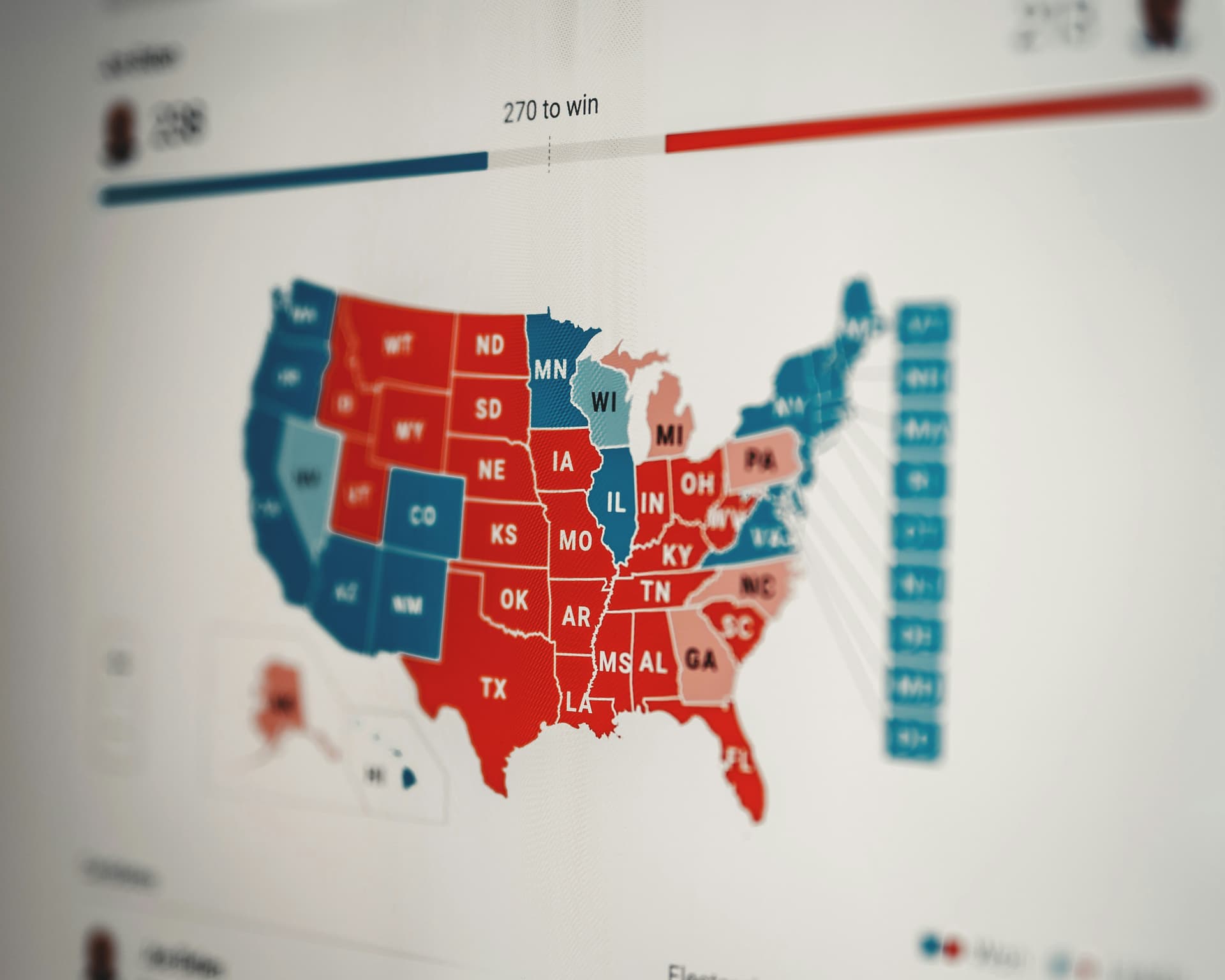
I live in Oklahoma, a state that today is unmistakably red. Republicans dominate Oklahoma politics. They hold the governor’s office and both chambers of the state Legislature, giving the party what political analysts call a trifecta - one party controlling the governor’s office, the state Senate and the state House. But Oklahoma wasn’t always a Republican state.
For much of my lifetime, Oklahoma was a predominantly Democratic state. So I began wondering: When did that change? Why did it change? And how many other states have experienced this kind of long-term political dominance?
The answers are more interesting than a simple red-versus-blue map.
Oklahoma’s political transformation
Republicans won control of both chambers of the Oklahoma Legislature for the first time in state history in 2008. Then, following the 2010 election, Republican Mary Fallin became governor. When she was sworn into office in January 2011, Republicans had their first statewide trifecta in Oklahoma, that has continued ever since.
By 2026, Oklahoma has experienced 15 consecutive years of Republican control of all three parts of state government. Fifteen years is a long time in politics. But Oklahoma is hardly alone.
Red states and blue states
According to MultiState’s 2026 state government data, 23 states have Republican trifectas, 16 have Democratic trifectas and 11 have divided government. Some of these political streaks are remarkable.
The eight longest-running Republican trifectas are:
Utah: 34 years, since 1992 Idaho: 31 years, since 1995 North Dakota: 31 years, since 1995 South Dakota: 31 years, since 1995 Florida: 27 years, since 1999 Nebraska: 26 years, since 2000 South Carolina: 23 years, since 2003 Texas: 23 years, since 2003
These numbers put Oklahoma’s 15-year streak into perspective. Oklahoma has a long way to go before approaching the nation’s longest-running Republican trifectas.
The longest-running Democratic trifectas
The Democratic side has its own long-running political strongholds:
Delaware: 17 years, since 2009 California: 15 years, since 2011 Connecticut: 15 years, since 2011 Hawaii: 15 years, since 2011 Oregon: 13 years, since 2013 Rhode Island: 12 years, since 2014 New Jersey: 8 years, since 2018 New Mexico: 7 years
Since 2019 New York, Colorado and Illinois also have Democratic trifectas dating to 2019, so they are tied with New Mexico at seven years.
Looking at those numbers made me stop and think.
We talk about red states and blue states as though they have always existed this way. But they haven’t.
And even the colors themselves aren’t as old as many of us might assume.
When did red become red and blue become blue?
Today, we automatically understand that red means Republican and blue means Democrat. But that wasn’t always the case.
For decades, television networks used different colors to represent the parties. The colors could even change from one election to another.
It wasn’t until around the 2000 presidential election that red became firmly associated with Republicans and blue with Democrats.
Larry Jacobs, a politics professor at the University of Minnesota, told CBS that it was around 2000 that the media began consistently associating red with Republicans and blue with Democrats.
So even something as seemingly permanent as a red state and a blue state is actually relatively new. Perhaps that should remind us that political landscapes can change.
But what happens when they don’t?
This is where my curiosity turned into a bigger question. If one political party controls a state for 15, 20 or even 30 years, are all of the state’s citizens being adequately represented?
A political party winning elections is democracy. If voters repeatedly choose the same party, that party has earned the right to govern.
But democracy is about more than winning elections, it is also about representation, competition, accountability and the willingness to listen to people who didn’t vote for you.
A Republican in a heavily Democratic state is still a citizen of that state. A Democrat in a heavily Republican state is still a citizen of that state.
And neither should feel that their voice doesn’t matter simply because their party is outnumbered.
That brings me back to Oklahoma.
I live in a state where Republicans have held the governor’s office and both legislative chambers for 15 years. That doesn’t mean every Oklahoman is Republican. It means Republicans have been more successful at winning elections.
Those are two very different things.
The same is true in California, where Democrats have maintained a trifecta for 15 years, or Utah, where Republicans have maintained one for 34 years.
The question isn’t whether those voters should be allowed to elect the candidates they want. The question is whether long-term one-party dominance creates a political environment in which the minority party becomes irrelevant rather than simply being in the minority. Is the playing field level?
That question becomes even more complicated when we move from state government to Congress. The United States Senate gives every state two senators, regardless of population. California and Wyoming have the same number of senators despite having dramatically different populations.
The House of Representatives is designed to reflect population, but congressional districts and the way they are drawn can affect how competitive elections become. At the state level, redistricting can create districts where the outcome is almost predetermined. When political competition disappears, voters may have fewer meaningful choices.
Sometimes the problem isn’t that people don’t want to participate.
Sometimes they don’t see a reason to.
Why vote if the outcome seems predetermined? Why run for office if the district is considered unwinnable?
Why get involved in a political party if decisions are being made by a small group of people who have held power for years?
Those questions should concern Democrats and Republicans alike.
Because political power is temporary.
History proves that. Oklahoma was once a Democratic stronghold.
Today it is a Republican stronghold.
Political maps that seem permanent can change.
We shouldn’t be afraid of red or blue
Perhaps the answer isn’t to make every state politically purple. Perhaps the answer is to make sure every citizen has a meaningful opportunity to participate in the political process, whether their state is red, blue or somewhere in between. A healthy democracy doesn’t require that both parties win the same number of elections. It requires that both parties, and independent voters, have the opportunity to compete for those votes.
Competition forces politicians to listen.
Accountability forces elected officials to explain their decisions, and voters who believe their votes matter are more likely to participate.
I don’t want to live in a country where we divide ourselves into red states and blue states and then stop listening to the people on the other side of the color line. We are not red people or blue people. We are Americans who happen to vote differently.
Maybe the better question isn’t “How do we make the political playing field equal?” Maybe it is: How do we make sure the political playing field remains open?
Today’s political minority could become tomorrow’s majority. Oklahoma is living proof.
Comments
Join the conversation. Comments are public and appear right away — please keep them civil and on topic.
No comments yet. Be the first to respond.