
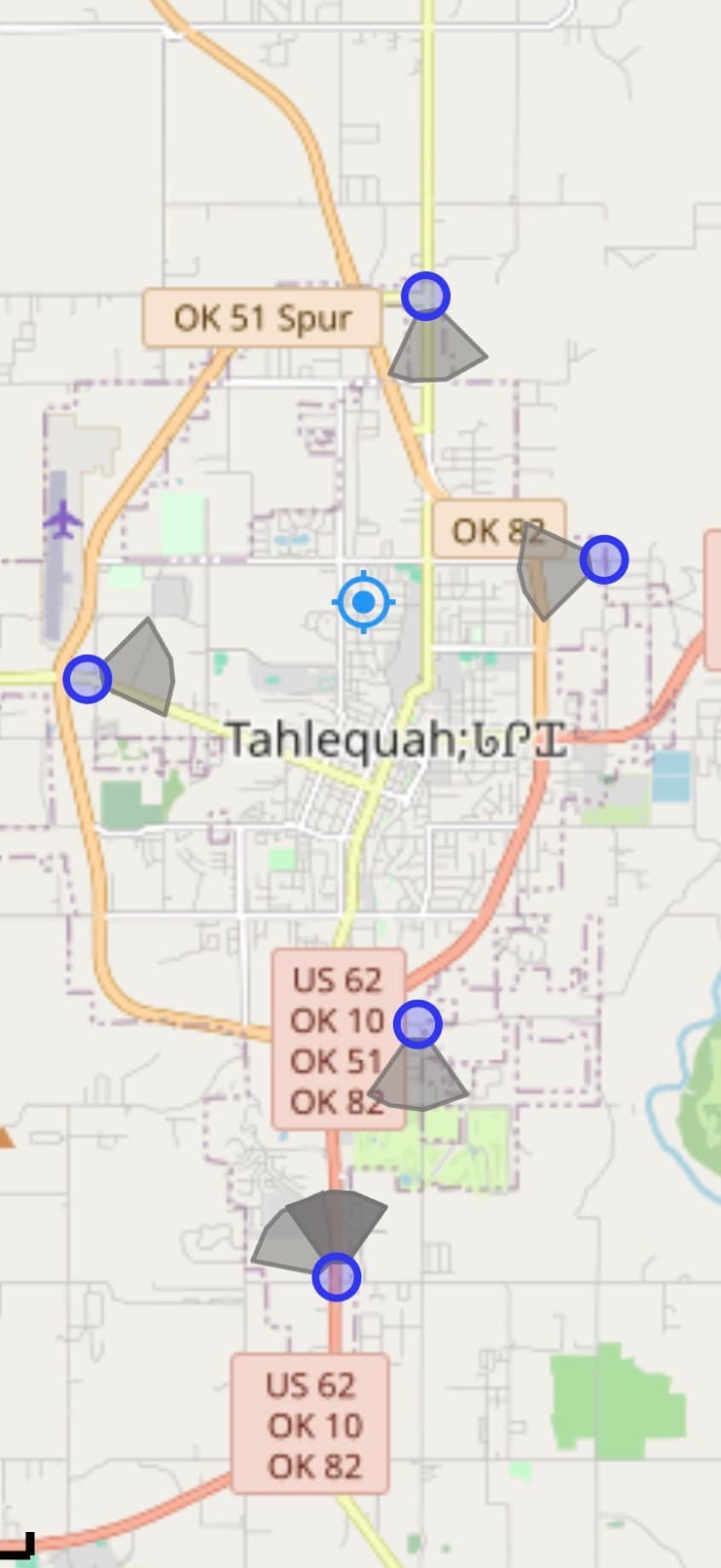
There are six Flock Safety cameras in Tahlequah right now. One sits near the police department. Another was bolted onto a traffic pole at Muskogee Avenue and Willis Road this summer, solar powered, so it never even needs a plug. If you have driven into town from pretty much any direction lately, one of them has already read your plate.
I used to think of mass surveillance as something that happened somewhere else. A Norfolk problem, or a big-city problem, or a problem for people who watch too many dystopian shows. It is not. It is a Muskogee Avenue problem. It is a two minute drive from my house problem.
The city council approved the cameras on July 7, a $21,900 contract, after Police Chief Nate King said the department had been looking into it for about two years. The pitch is simple and honestly pretty compelling on its face: the cameras have flagged 30 stolen vehicles, one missing person, and two warrants since they went in. Officers say every alert gets verified before anyone gets pulled over. Assistant Police Chief Dexter Scott has described the Muskogee Avenue camera as strictly investigative, meant to catch a missing person or a stolen car passing through, not to write speeding tickets.
I believe that is genuinely what the department intends to use it for. I do not think Chief King is lying to us. But intentions are not the same thing as infrastructure, and infrastructure outlives whoever is currently in charge of it.
Here is what the cameras actually are, underneath the pitch. They are automated license plate readers built by a company called Flock Safety, and they do not just snap a photo when they think you have done something wrong. They log every plate that passes, log the time, log the direction you were headed, and hold onto that for weeks. A retired veteran in Norfolk, Virginia found out he had been logged 526 times in about four and a half months, four times a day, by a network of 176 cameras across his city. He is now part of a lawsuit that may end up in front of the Supreme Court, arguing that this kind of tracking without a warrant violates the Fourth Amendment. An attorney on that case put it plainly: Flock has built a nationwide business that lets the government track millions of people for weeks at a time, and nobody signed off on that.
Since I started looking into this, I have also seen a lot of people claiming the cameras scan your phone's Bluetooth to track you too. I wanted to get that right before repeating it, so I checked. Independent teardowns of the actual camera hardware confirm two things for certain. The infrared LEDs are real, and they exist to illuminate license plates for clear night photos, not to give the camera some kind of night vision on everything around it. The Bluetooth radio is also real, but the best documented use for it is the camera reporting its own battery health back to itself, not scanning your phone. There is a company, Leonardo, that sells a product built specifically to sweep up phone signals from passing cars. That is not Flock. Whether Flock's own cameras are quietly doing something similar is genuinely an open question researchers are still trying to answer, not a settled fact. I am not going to tell you something is happening that I cannot confirm. But I am also not going to pretend the hardware capable of it isn't sitting on a pole at Muskogee and Willis.
What is settled is where this technology has already gone wrong. Reporting has shown local police departments sharing Flock data with ICE and CBP even in places where state law bans it outright. Evanston found its database had been searched by ICE seven times and revoked outside access. A California class action accuses Flock of helping track millions of people's daily movements and illegally sharing that with out-of-state agencies. This is not hypothetical. It is documented, it happened, and it happened through the same company whose cameras are now reading plates on our streets.
And communities are pushing back, including ones a lot like ours. Five days ago, every single member of Norman's nine-person city council voted against a Flock contract, after two years of public debate. The mayor said thirty days felt like too long to hold that much data on ordinary people. He asked what kind of life we are living if we accept that as normal. Oklahoma City and Bartlesville have both paused their renewals. The ACLU of Oklahoma is on record urging an immediate stop. Nationally, 82 Flock contracts have been cancelled across 28 states since 2021.
I am not writing this to tell Tahlequah the cameras have to go. I am writing it because six cameras went up in my town after two years of internal discussion, and most of us found out from a headline, not a public debate. If you want to see exactly where the cameras near you are, there is a crowdsourced map called DeFlock that tracks them, built by the same kind of people who are asking the questions city councils in Norman and Austin and Denver have already started asking out loud.
We do not have to be against safety to ask what thirty days of location data on every car in Tahlequah is actually for, who gets to see it, and what happens to it once the company that built the camera decides to change its mind.
Luke Johnson is co-founder and publisher of the Northeastern Journal.


Comments
Join the conversation. Comments are public and appear right away — please keep them civil and on topic.
No comments yet. Be the first to respond.