

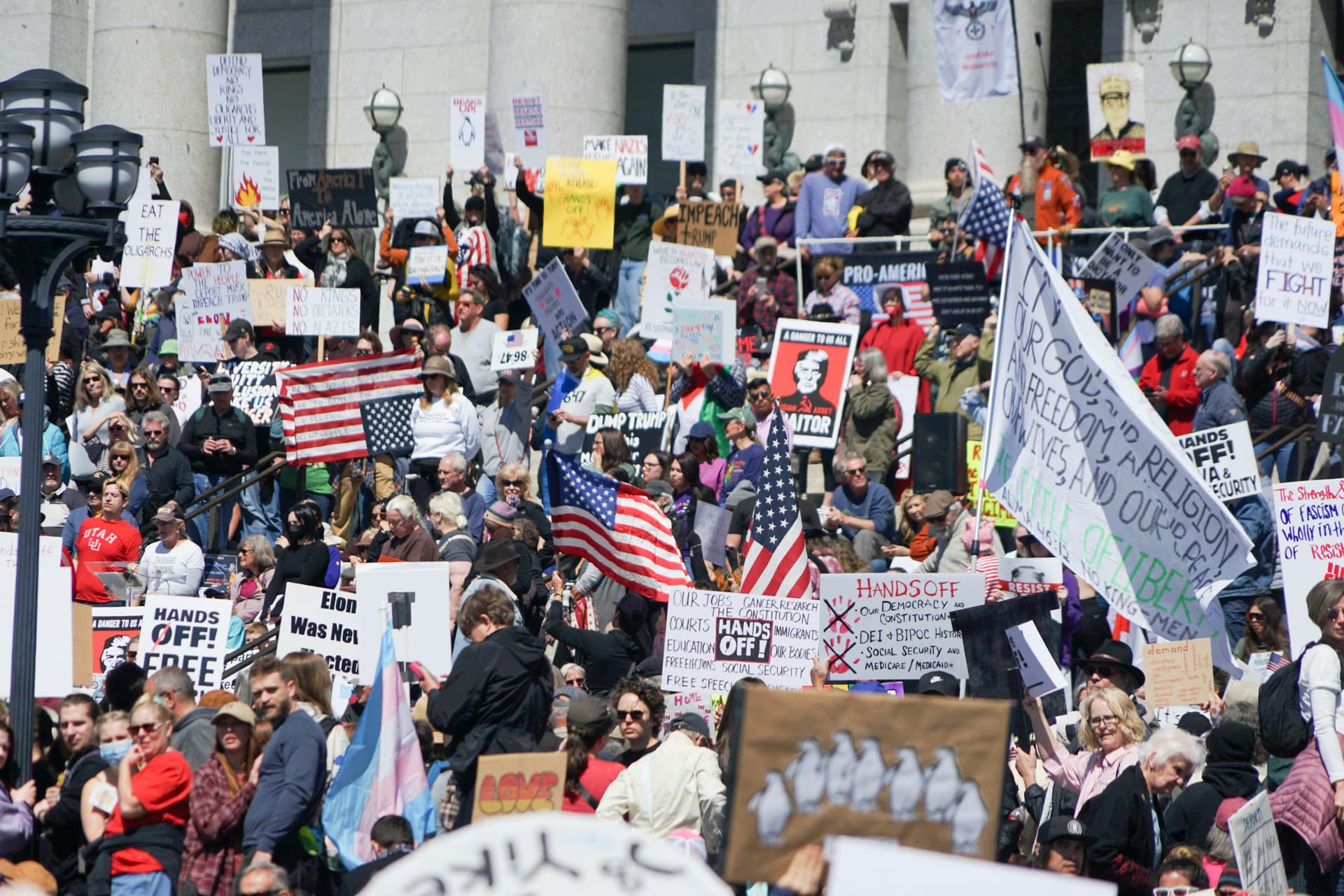
I was fourteen, standing in a crowd in Tulsa at one of Bernie Sanders' "Fighting Oligarchy" rallies with my Nana, Cheryl Leeds, when I found out the United States had struck Iran's nuclear facilities. Bernie was mid-speech. A woman near us screamed, "We just bombed Iran!" Then another voice picked it up, and another, until the shout was moving through the crowd faster than any of us could process it. A staffer ran a printed statement onto the stage. Bernie read it silently first, then read Trump's opening line out loud, and the crowd erupted into chants of "no more war." He let it go on for a few seconds before he responded. He called the strikes "grossly unconstitutional," and said the only entity with the power to take this country to war is Congress, not the president. I remember thinking that a senator who had spent forty years in Washington was finding out about a new war from a rally crowd the same way I was. That felt like it should have unsettled more people than it did.
What strikes me most, watching everything that has unfolded since, isn't any particular battlefield development. It's how little I, or anyone my age, was ever actually consulted about any of it, not in the literal sense, since nobody expects a fifteen-year-old's vote on foreign policy, but in the structural sense, meaning who gets consulted at all. This has become a war fought through strikes, ceasefires, collapsed diplomatic settlements, and renewed strikes again, and at no point has it involved anything resembling the kind of public deliberation that's supposed to precede this scale of military commitment. There was no congressional declaration of war. A ceasefire brokered by Pakistan in April held for a while, and diplomatic talks over a formal settlement dragged on for months afterward. By early July, Iranian attacks on commercial shipping in the Strait of Hormuz prompted the American president to declare the truce effectively over, and the conflict escalated again in the days that followed. As of this writing, Iranian officials are warning that the United States is accelerating toward a full-scale regional war, following threats of American strikes on Iranian energy infrastructure.
I bring up the mechanics of how this war started and restarted because I think they matter more than they're usually given credit for. The Constitution gives Congress the power to declare war for a reason, not as a formality, but as a check that requires an actual accounting from elected representatives before the country commits to something this consequential. That check has been eroding for decades, across administrations of both parties, until executive military action without congressional authorization has become less an exception than a default. My generation has never really known it any other way. We grew up after Iraq, after Afghanistan, after a two-decade stretch where "the United States is in a war somewhere" was closer to background noise than a live political question requiring public consent. I don't think that's a healthy inheritance, and I don't think it's something either party has been especially eager to fix, because the erosion has benefited whichever party controlled the executive branch at any given moment.
There's also something specific about how this war has been experienced informationally that I think matters for people my age. The conflict has caused mass displacement inside Iran, damaged infrastructure, triggered internet blackouts, and led to documented human rights concerns, including reports of minors being used in military-related activity. Almost none of that reaches the average American teenager's daily information diet in any sustained way. We get fragments: a headline about a strike, a clip of a press conference, a meme referencing "World War III" that gets treated as a joke because the alternative is sitting with how serious it actually is. I don't say this to romanticize some imagined past where Americans followed foreign policy more closely. I say it because the gap between how consequential this war is and how thinly most people my age are actually informed about it feels like its own civic failure, sitting on top of the structural one.
There's an argument I keep coming back to that I first heard articulated clearly at that same rally, before any of us knew a war was starting. Every dollar this country commits to a war is a dollar it chose not to spend keeping people alive, housed, and cared for at home. I don't think that's a subtle point and I've stopped pretending it needs to be softened into "opportunity cost" to be taken seriously. This is a country that lets people ration insulin, that lets kids go to school in buildings with mold in the ceiling tiles, that treats a national healthcare guarantee as a fantasy too expensive to seriously legislate, and then finds hundreds of billions of dollars for a war within days, with no vote, no debate, and no accounting to the public that pays for it. That's not a coincidence and it's not an accident of budgeting. It's a demonstration of what this government actually considers non-negotiable, and it isn't us. Military spending gets treated as beyond question. Medicaid, food assistance, and public education get treated as a burden to be justified line by line, year after year, by the very people who need them most. I'm done pretending that split reflects some careful, values-neutral calculation. It reflects who this system is actually built to protect, and it is not the people standing in that crowd in Tulsa, and it is not the people in Iran whose lives get treated as an acceptable cost of someone else's strategy.
I'm not going to pretend I have some tactical answer for what happens next in the Strait of Hormuz. But I don't think this requires a tactical answer to be worth saying plainly: a government that can find unlimited money for war and only ever finds scarcity for the people it governs has told you exactly what it values, and it isn't a mistake that needs correcting at the margins. It's a system working exactly as it's built to work, for the people it's built to serve, and neither political party has shown much appetite for dismantling that arrangement, because both have benefited from it when it was their turn to hold the war powers nobody in Congress ever bothered to reclaim. A generation raised on strikes, ceasefires, and renewed strikes, without ever once seeing the public authorization process the Constitution actually requires, is being trained to accept that decisions of this magnitude simply happen somewhere above our heads. I refuse to accept that as natural. It's a choice, made over and over, by people who never have to answer for the cost the way the people in that crowd, or the people in Iran, do.
I can't vote yet. But I'll be old enough to by the next time this question comes up, and when it does, I'm not interested in a candidate who treats war as something the public deserves to be informed of after the fact and grateful for otherwise. I want the whole arrangement rebuilt from the ground up, starting with who actually gets to decide, and what we owe each other before we ever decide to spend a single dollar on ending someone else's life instead of building someone else's.


Comments
Join the conversation. Comments are public and appear right away — please keep them civil and on topic.
No comments yet. Be the first to respond.